The many faces of a Chopin medallion

•June 13, 2009 • 2 Comments

This is try #2. Almost finished. Working at this size (2″ diameter, 1.5″ portrait) means the portrait changes by the smallest of adjustments.  It requires infinite amounts of patience, perseverence, discipline. I find that if I work on it for more then 2-3 hrs a day, frustration and impatience sets in, which inevitably leads to distraction of the work. Sadly, the one after this one fell victim to impatience.  

I thought it would be interesting to post the changing faces as I went along. The first pic is to show the actual size of the medallion.

Chopinactualsize

Chopintry21Chopintry22Chopintry23Chopintry24Chopintry27Chopinunfired


I just need to work a bit more on the direction of the eyes. Unfortunately the piece is dry, so not sure  how much more can I do.

New Mano pendants

•June 4, 2009 • Leave a Comment

Yeah, that’s all I do these days: manos and Chopin. Yawn. They’re more colourful though, and I came up with  new backdrop ideas.

They’re available at http://www.manoworld.etsy.com

Mano15sm


Mano17sm5

 Mano11

I’m selling my figurative pendants on Etsy

•May 25, 2009 • Leave a Comment

Finally, afther much going back and forth on this idea, I’ve decided to start selling my “mano” pendants on Etsy, which seems to be the best choice for handmade small items.  I will have to work a lot more on the “shop” in the coming weeks.

Here is Manoworld’s page: http://www.etsy.com/shop.php?user_id=7397849 

Mano4smThey’re small, most 1″x1.5″, so the quality of my photos are lacking not having macro on my camera. The good thing is, all of these little guys look so much better in real life. Mano5sm

Mano6sm

Chopin Medallion 1: Day 2,3 and 4

•May 21, 2009 • 2 Comments

See part 1 here:

http://erikatakacs.wordpress.com/2009/05/20/chopin-medallion-1-day-1/

The Chopin portrait I’m using:

HU019236

Chopin17

Today’s progress: I’m adding small lumps of clay, trying to cover the whole face, and not get caught into too much detail yet. I find the tiny bits of clay harden  very fast, so I dip them in water, then put them on a sponge that soaks up the water and gives me the right consistency.Chopin18

Brushing water on surfaces I’m not working on. Chopin19

I add the tiny eyeballs, but it seems like a bad idea.  This is where I feel helpless. It looks bad and hopeless. Got a headache too.Chopin120 Just when I want to give up, a lifesaver idea:  I use the small tool on the left for detailing and a paintbrush for smoothing/refining lines. This might actually work. I remove the bad eyes for now.Chopin121

This is how it looks after brushing the whole face. Chopin122


That’s it for today. I think I’ll keep using this technique, and deepen, roughen some of the lines for deeper shadows effects. Now if I could get the likeness, it would be really nice! I think his face is too round, I’ll have to elongate it around the jawlines.

DAY 3

First shot in natural light:

Chopin123


I can’t believe 4 hrs later there are hardly any perceivable changes. My only goal was working on  likeness. I worked on his eyes for a long time, only to remove them again. I might leave them hollow. Some areas improved slightly, some got worse, but I know where to make the corrections.


Second shot in direct sunlight:Chopin124                                                                                                                           


Third shot with flash:   

   Chopin125          


Day 4:     

Everything was going fine today until I noticed the portrait has shifted from the centre a lot .  Next time I should remember to cut out the shape of the medallion after the relief is finished. The holes were not in the right place either. So I came up with a different design for the plate:       Chopin126                                                                                                                                                         


  Looking at this photo I  saw more changes were needed in the area between his nose and the eyebrows  and the left eye and a few others. It started to look more like the picture.    I decided to add a neck instead of the piano keys that are still visible on this pic.   I pondered whether I should leave the outlines around the head for decoration. I thought brought some interesting  asymmetry to  the round shape of the medallion. Unfortunately the lines were just too close to the edge of the plate. Instead of playing more with different outlines, I decided to remove all the clay outside the lines.  

Chopin127Bad, bad decision. It looked terrible. To save my hard work I decided to attach it to a new, thinner piece of clay.Chopin128


Chopin’s face had already suffered due to mentioned removal. But now I had to press the face onto the clay slab to stick.  He looked fatter and older.  I took a tool and abused it for a while, then gave up.Chopin129

This is how he looks now. Pretty botched.  I don’t know if it can be saved now. I’m leaning towards starting a new one.

Chopin medallion 1: Day 1

•May 20, 2009 • 2 Comments

My new project is a medallion with Chopin’s portrait. I will try to document every step for my own benefit and anyone who is interested in trying low relief. The biggest challenge is the sheer size of the medallion and the likeness of course. This is my first take, I’m sure there will be many more. Right now I don’t know what I’m doing, just hoping to learn along the way.

I happened to buy Eduard Lanteri’s excellent book Modelling and Sculpting the Human Figure a while ago, and I was happy to discover it had a whole chapter on modelling coins/medallions. I think I’ll use the book as my art Bible.

I’m very eager and anxious to start, there’s anticipation, hope but also fear of failure. It never gets better.

Chopin11Here are most of the tools I thought I might need, I even made one myself. The little white tool was made of a piece of galvanized wire and paper mache for handle.  Last week I rendered two sketches of Chopin after the painting on the picture, which I  deliberately printed small. Lanteri emphasizes the need to simplify wherever possible. The most dominant features should be captured in most part without much detail. I think Chopin has some very strong features on this portrait, features that I like, so hopefully that will help keeping my interest.


Chopin12

I’m using air dry clay. The pencils help with rolling out the clay evenly. The clay is very soft, so I covered it with cling wrap. It won’t stick to the rolling pin. Thickness is about 1/4″ as I don’t know at this point how much the clay will shrink. It seems a bit too thick.


Chopin13

Most coins/medallions are between 2-4 inches in size traditionally. I chose 3 inches. I cut out the shape in paper in advance. I’m using the pin tool to cut out the shape in clay.


Chopin14

This is how it looks. The clay is too soft for the relief, so I left it dry a bit, for about 1/2 hrs.


Chopin15

I draw the basic shape of the design.


Chopin16

The base is still too soft, so I softened the piece for the relief even more, which made it muddy and difficult to place the tiny pieces in just the right spot. Lanteri suggests building up the clay from thin at the edges to thicker in the middle.

Next time I’ll have to remember to let the base dry covered in plastic for a day. It needs to harden a bit more.

An hour later the relief is still too soft to work it, so it has to wait until tomorrow.

See day 2 progress here:

http://erikatakacs.wordpress.com/2009/05/21/chopin-medallion-1-day-2/

Fun sculpted pendants

•May 5, 2009 • 5 Comments

I will start selling these little creatures, “Mano”‘-s  sometime soon. They’re fun and easy to make. Mano is a childlike, mischievous little creature in Hungarian fairy tales.  Anyone interested contact me at erika@erikatakacs.com

mano1mano2mano3

Morta: Work in Progress

•April 17, 2009 • 5 Comments

Morta is one of the Fates in Roman mythology, the one who cuts the thread of life.  She will not be shown in the conventional sense, I will add my own twist to it, but much about that later. Too tired for more words today.  I see from the statistics that people like step-by-step, so tried to take pics as I went along.

I will add more pics to this entry next week.

morta1morta2morta3morta4morta5morta6morta7morta8morta9morta102morta111morta122


The next stage sure was a  pain, two days’ work. I had to distroy all yesterday’s work and try again today, because I didn’t want mitten hands. :) Today I decided to build the fingers on wire support, but that didn’t work. These are the best hands I could make at this scale. The difficulty with mache and delicate detail is that if it’s too soft, won’t hold, if it’s too firm it will crumble or break. The only thing I can do now is sanding when dry.

Her face didn’t shrink too much, but small adjusting is needed. Hope she won’t use her expression. Tomorrow I’ll refine the piece and hopefully by the end of the weel she’ll be done.morta141


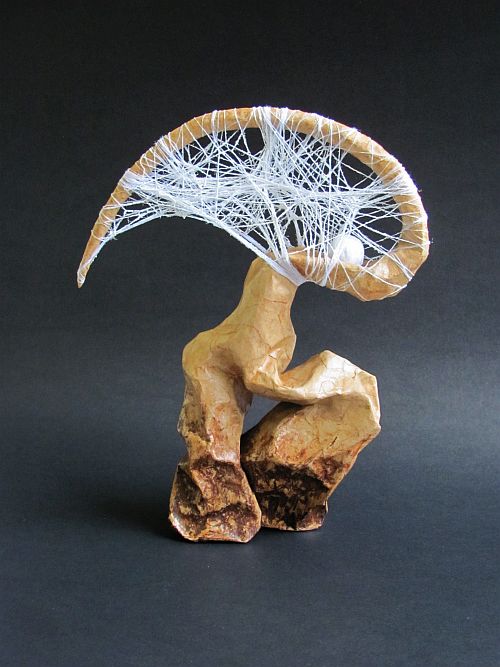
Here she is with the thread of life. My story goes like this: though she does her job diligently, once in a while, when the wool drops by accident (that clumsy Nona!), with the instinct of  a predator , she steps on it. Next she’ll take her terrible scissors, and a human dies somewhere…by accident. I tried to show the innocence of the predator with this piece, and the power.  Right now she only has a wire in her hands. I will need a base, before covering the thread in the final position.


morta151morta16morta17morta18